

Scott 3
Reflections of a magestiral musician

In the journey through Scott’s heart of darkness from the pop sensation lead singer of The Walker Brothers to the obsessive control freak orchestrating his percussionists to punch a slab of pork Scott 3 holds a vital and important position. It steps even further into the orchestral narratives of his greatest work, but still garnered chart success unlike its successor Scott 4. It demonstrates Scott taking further steps away from his influences to create something new. “Scott 3 is a remarkable record: a pop crooner breaking out of his pop restrictions and moving into dark territory” I once wrote, and I don’t think I have ever been more correct.
His first two solo albums were sprinkled with originals sitting side by side with covers of music by Jacques Brel, Tim Hardin, Bacharach and David, Weil and Mann and even Andre and Dory Previn. Scott 3 ends with three covers of Brel numbers but the bulk of songs were written by Walker, and it’s this step into greater creative control that makes the record so compelling.
By modern standards, and his own work post-1980, this isn’t challenging or difficult material, but there’s still a slice of darkness that runs through each track, baroque pop music with a dark underbelly, existential and brooding.
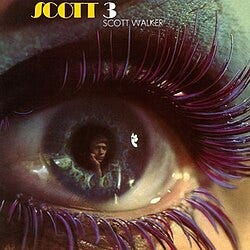
The cover is one of the most beautiful and hypnotic album covers I have seen: Scott looks pensive and mysterious as he is reflected in the liquid blue eye of an unnamed girl, her long eyelashes almost purple in the light. She is looking at him and although he’s looking back at her he’s clearly thinking about something, or someone, else. It reflects the introspection and the dark narratives of the album.
Side one
The album opens with the rising and then dancing strings of It’s Raining Today. The strings are almost atonal and add a repetitive wash behind Scott’s dark voice. It’s a stunning poem, a reflection on a lost love with Scott’s typically matter-of-fact lyrics that are still tinged with poetry.
I've hung around too long
Listenin' to the old landlady's hard-luck stories
You out of me, me out of you
There’s a moment where the strings shriek a curtain across the music, before we move back into the glacial and beautiful melody.
On Copenhagen we get an easy listening ballad, partly a love song for the city where his wife Mette came from. The second verse is delightful and different to the first: staccato, plucked strings as he sings
Copenhagen, you’re the end
Gone and made me a child again
As he sings of a children’s carousel the music picks up, a fairground waltz, dancing with us to the fade.
Rosemary is a stunning story-led song, the strings, arranged by Angela Morley, slice a black shadow of concern for Rosemary, living with her mother, a distance from a summer romance with “that travelling salesman” who “smelt of miracles with stained glass whispers”. It’s a deeply sad story, and although the albums was a success, it was Walker’s last solo success until his resurgence in the 80s. The darkness is at odds with his pop personality, with the man presenting a BBC show and singing the easy listening hits of the time. On Rosemary Scott takes that next, big step, into a narrative pop music that would influence so many indie writers of the 80s and 90s, with touches such as its brittle and sad ending:
That’s what I want
A new shot at life
But my coat’s too thin, my feet won’t fly
And I watch the wind and I see another dream
Blowin’ by
Big Louise is famously the song that gave Julian Cope the title for his notorious 80s Scott Walker compilation, Fire Escape in the Sky: The Godlike Genius of Scott Walker. Cope may have cooled with his love for Walker, but I still love his music as much as I always have. This opens with a cinematic orchestra section, horns swelling and dipping, and the melody is delicate and quite beautiful. The song tells of Louise as she contemplates the world, all alone in her house
She’s a haunted house
And her windows are broken
And the sad young man’s gone away
There’s a country tinge to the chorus, but the orchestral strings and horns transport the track to a different place, dark and lonely.
“I am not competing with pop writers, what I do is polish up the antique and bring something fresh to the work,” Walker said at the time and this can be heard in the cavalry charge of We Came Through. This is Walker reflecting Brel’s influence at its most clear pulling on military imagery as he cries of his band of brothers, but this isn’t just a song of military prowess but a song of the reality of revolution, name checking Che Guevara and Martin Luther King but reminding us that “we watch our kings and countries raise their shields” to maintain the status quo. It’s over in less than two minutes, a cinematic intermission of the sort that fill this record.
Butterfly is Scott channeling Rossini-like classical music, a flute darting and dancing like the insect of the title. It’s another short musical interlude, a fragment of poetry set to music that fits it perfectly, and Scott’s magical baritone is ideal for the tale of the flitting butterfly that lands on someone’s hair.
Two Ragged Soldiers is built around warm acoustic guitars that are supported by a gentle orchestral sound, a tale of two old friends, possibly homeless in Walker’s dense elliptical lyrics, broken by time where one “had no memories left for his mind…”
Side two
Clanging acoustic guitar chords open side two and Scott sings one of his most remarkable songs, words opaque and full of unknown meaning
See the dwarves and see the giants
Which one would you choose to be?
And if you can’t get that together
Here’s the answer, here’s the key
It seems to allude to freeing time for the future, overcoming the uncool world of the 20th century and preserving yourself and everything you need (“saran wrap all you can”) for a time in “a hundred years or so”. It’s a folk rock masterpiece in a minute and a half.
Winter Night opens like a radio play, doom-laden strings introduce our narrator describing a person who is cool inside and out, the snow a metaphor for their loneliness and the “icy tears” that “glisten for someone.” Like many of the tracks on the record, it is fragmentary and brief, but builds a wonderful, tangible world in the short time the song lives.
The final track written by Walker is Two Weeks Since You’ve Gone. It’s his version of the crooner’s introspective ballad, but by this time Scott was so steeped in film, art and literature he can’t help but make it sound panoramic and cinematic. The imagery is pure poetry.
With whom are you sharing the sweet taste of summer?
My memories pursue you through puddles of rain
The rivers inside me still flow
To the sea of your hand
The music baroque and beautiful, weeping behind his dark voice. There are parallels to the work of Sinatra, but this is more than whiskey-drenched jazz crooning, Scott’s tale of this brief but touching relationship features delicate touches of orchestra that underline his imagery to perfection.
The album finished with three covers of Jacques Brel songs, a need for Walker to get Brel out of his system. The first, Sons Of, is a fairy tale, with lyrics by Mort Shuman, and it features a sweet organ line that waltzes along as the song dances, the track building with energy until it becomes a whirling, spinning reel by the end.
Funeral Tango is a slight and silly song, a comic vignette about a death, sung from the point of the body. It allows Walker to sing with expressive style, playing his characters with a flourish, but it was time for him to move away from this kind of material.
The album ends with one of his more well known Brel covers. If You Go Away was a well known translation of Brel’s Ne me quitte pas, and there had been a number of versions of the song by 1969. Walker sings it with dark precision, and it is perfect for him, full of drama “If you go away…then you might as well take the sun away”, and flooding with hope and promise for a future love
But, if you stay, I'll make you a day
Like no day has been or will be again
We'll sail the sun, we'll ride on the rain
And talk to the trees, and worship the wind
The music waltzes slowly, acoustic guitar ringing and strings swooping and crying. It works as a final track on an incredible work of art, Scott’s voice as clear and as good as it would ever be.
We can argue all day about what his greatest album is, but Scott 3 stands as a vital piece of work that everyone must hear.
Agree or disagree? Leave a comment!
Like what you read? Buy me a coffee!
About me
I have a radio show, Single Minded, on Radio Alty, every week on Wednesday at 8pm (UK). Listen here:
Older shows can be found here:

I have also written a book about the great singles of the 1960s which can be found on Amazon:
Can't believe I missed that typo! Majestic is the wors I meant!!!